
Mr. Nadeem Mahbub, Federal Secretary, Ministry of Federal Education and Professional Training, graced the launch of the ASER Pakistan National Report 2025
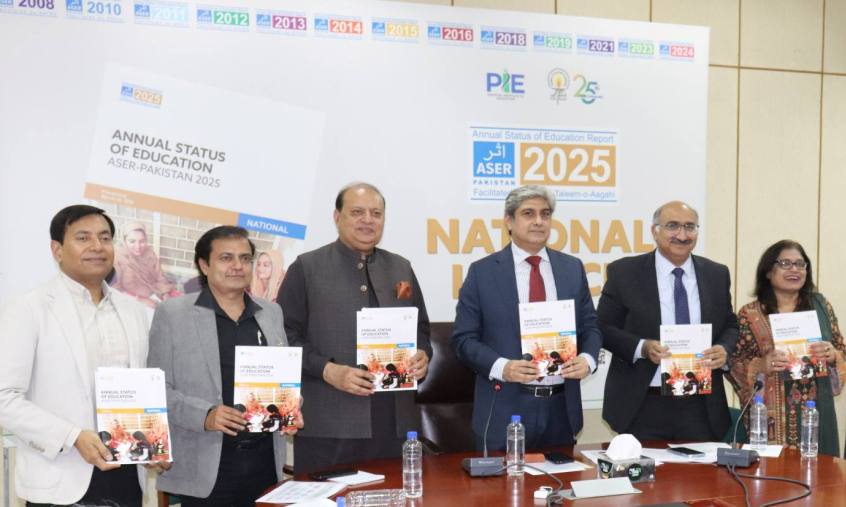
Mr. Nadeem Mahbub, Federal Secretary, Ministry of Federal Education and Professional Training, graced the launch of the ASER Pakistan National Report 2025 as Chief Guest and chaired the high-level panel, reaffirming the government’s strong commitment to improving education outcomes across Pakistan. In his remarks, he appreciated the scale and rigor of ASER as a citizen-led initiative that provides credible, evidence-based insights to guide policy and planning. He emphasized the importance of translating data into action, particularly to address persistent gaps in foundational learning, equity, and access, and highlighted the Ministry’s resolve to accelerate progress toward Article 25-A and SDG 4. ASER assesses all children aged 5–16 using Grade 2/3 level tools aligned with the national curriculum. The findings show persistently low foundational learning levels. At the national level, 52% of Class 5 children can read a Class 2 level story in Urdu/Sindhi, 56% can read English sentences, and 50% can perform two-digit division. Private school students perform better than government school students, and girls outperform boys. Urban children outperform their rural counterparts across all competencies. According to report, Nationally, 49% of girls and 48% of boys can read sentences in Urdu/Sindhi, 25% of girls versus 24% of boys can read English words, and 54% of girls compared to 53% of boys can perform subtraction. Foundational literacy and numeracy levels remain low across grades, indicating rising learning poverty. Private Tuition is widespread, with 25% of government school students and 50% of private school students attending tuition. Nationally, 35% of girls and 30% of boys take private tuition, with higher prevalence in urban areas (42%) compared to rural areas (25%). Multi-Grade Teaching persists, with 30% of government schools and 20% of private schools reporting combined classes at Grade 2 level, while 7% of Grade 8 classes in both sectors have multiple grades taught together.